High Altitude Recipe
High Altitude Brownies Recipe
This is the recipe page for bakers searching for fudgy high altitude brownies, not just a troubleshooting chart. Start with the base formula, choose your elevation row, then use the texture fixes if your batch turns dry, cakey, sunken, or under-set in the middle.
Fudgy High Altitude Brownies
Yield: 16 brownies. Prep: 15 minutes. Bake: about 25 minutes at 350°F at sea level; at altitude, start checking at 19 to 22 minutes (see your elevation row). Cool: at least 45 minutes before slicing.
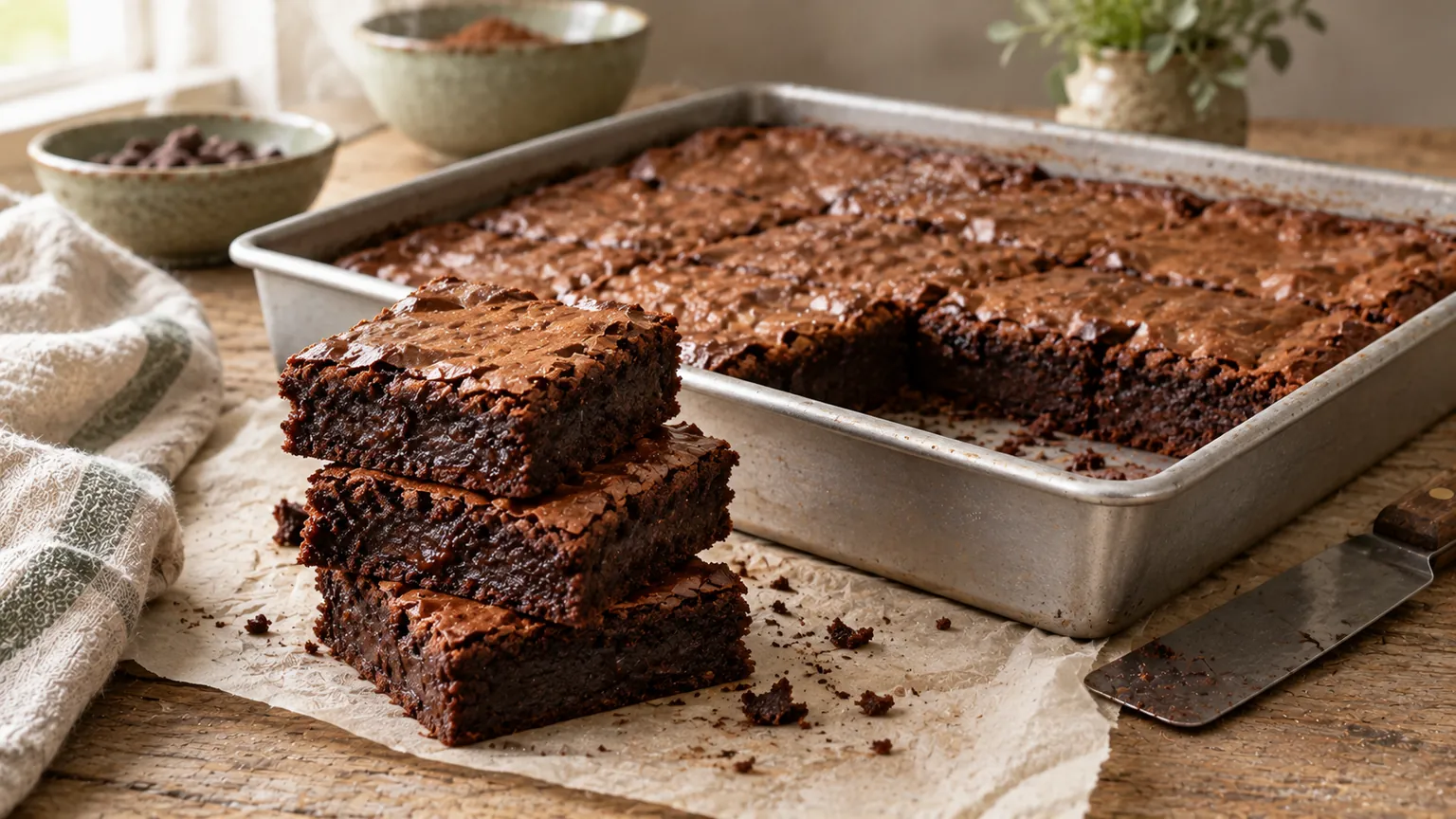
Ingredients
- 10 tablespoons unsalted butter, melted and warm
- 1 cup granulated sugar
- 1/3 cup packed brown sugar
- 2 large eggs, room temperature
- 1 teaspoon vanilla extract
- 3/4 cup unsweetened cocoa powder
- 3/4 cup all-purpose flour, plus the flour adjustment for your elevation
- 1/2 teaspoon fine salt
- Optional: 1/4 teaspoon baking powder for a slightly cakier brownie
- 1 to 3 tablespoons water, coffee, or milk based on elevation
- Optional: 1/2 cup chocolate chips or chopped chocolate
Instructions
- Heat the oven using the elevation table. Line an 8x8 metal pan with parchment and lightly grease it.
- Whisk warm melted butter with both sugars until glossy.
- Whisk in eggs and vanilla until smooth, then stop before the batter gets foamy.
- Fold in cocoa, flour, salt, optional baking powder, and your elevation flour adjustment.
- Fold in the altitude liquid and optional chocolate chips.
- Bake until edges are set and a center tester shows moist crumbs, not wet batter. Start checking at the time in your elevation row.
- Cool at least 45 minutes before slicing so the center finishes setting.
The Whole Recipe on One Chart
This is the same recipe as the card above, laid out so you can see every step at once. Pick your elevation and the shaded cells change to match the altitude table below.
Shaded cells change with elevation. Showing 5,000 ft. Swipe the chart sideways to see every step.
| Heat oven to 360°F to 365°F | |||||||
| Line an 8x8 metal pan with parchment and lightly grease it | |||||||
| 10 tbsp unsalted butter | melt, use warm | whisk until glossy | whisk in until smooth; stop before it gets foamy | fold in | fold in the liquid, then the chips | bake at 360°F to 365°F, first check at 20 to 21 min; done when the edges are set and a center tester shows moist crumbs, not wet batter | cool at least 45 min before slicing |
|---|---|---|---|---|---|---|---|
| 1 cup granulated sugar | |||||||
| 1/3 cup packed brown sugar | |||||||
| 2 large eggs, room temperature | |||||||
| 1 tsp vanilla extract | |||||||
| 3/4 cup unsweetened cocoa powder | |||||||
| 3/4 cup + 1 to 2 tbsp all-purpose flour | |||||||
| 1/2 tsp fine salt | |||||||
| 1/4 tsp baking powder, cut by 15%, for a slightly cakier brownie (optional) | |||||||
| 1 to 2 tbsp water, coffee, or milk | |||||||
| 1/2 cup chocolate chips or chopped chocolate (optional) | |||||||
How to Read This Chart
- Start with the top rows: heat the oven and line the pan before you melt the butter.
- Read each ingredient row from left to right. The first cell to the right of an ingredient is what you do to it. A cell that spans several ingredients combines them.
- This is a one-bowl recipe. The cocoa, flour, salt, and baking powder have no step of their own, so their cells stretch across to “fold in”: they go straight into the egg batter, with no separate bowl.
- The liquid and chocolate chips go in last, then the last columns span every row: bake, then cool.
The layout is the tabular recipe format Michael Chu popularized on Cooking For Engineers in 2004. We added the elevation picker.
What Changes With Elevation, and Why
- The oven goes up, but gently. Rising and evaporation both happen faster at altitude, so a hotter oven sets the structure sooner. The guide below recommends the smaller oven increase for chocolate bakes, and these rows stay on the cautious side.
- The first check comes earlier. A hotter oven finishes the pan sooner, so each row starts checking a few minutes before the 25-minute sea-level time.
- Liquid goes up. Extra liquid keeps the brownies from drying out at the higher oven temperature and faster evaporation.
- Flour goes up a little. A spoonful or two helps strengthen the structure.
- Baking powder goes down, if you use it. Leavening works faster at altitude, so the optional baking powder is trimmed as elevation rises.
Source for these reasons: NMSU Extension Guide E-215, High-Altitude Baking. The amounts are this recipe’s own starting points from the altitude table.
Brownie High Altitude Adjustments by Elevation
Use these rows as starting points for one 8x8 pan. At sea level this recipe bakes about 25 minutes at 350°F; each row gives the first check against that time. If you are adapting a different brownie recipe, keep the recipe fixed for one test batch and change only the altitude row variables first.
| Elevation | Flour | Liquid | Leavening | Oven | Timing |
|---|---|---|---|---|---|
| 3,000 ft | +1 tbsp flour if batter is loose | +1 tbsp water, coffee, or milk | reduce baking powder by about 10% if used | 355°F to 360°F | first check at 22 min (3 min early) |
| 5,000 ft | +1 to 2 tbsp flour | +1 to 2 tbsp water, coffee, or milk | reduce baking powder by 15% if used | 360°F to 365°F | first check at 20 to 21 min (4 to 5 min early) |
| 7,000 ft | +2 tbsp flour | +2 tbsp water, coffee, or milk | reduce baking powder by 20% if used | 365°F | first check at 19 to 20 min (5 to 6 min early) |
| 9,000 ft | +2 to 3 tbsp flour | +2 to 3 tbsp water, coffee, or milk | reduce baking powder by 20% to 25% if used | 365°F to 370°F | first check at 19 min (6 min early) |
Worked example
Adapting a Sea-Level Brownie Recipe for Denver
Suppose your sea-level brownie recipe uses 3/4 cup flour, 1 cup granulated sugar, 1/3 cup brown sugar, two eggs, and a 350°F bake. In Denver, around 5,280 feet, the first test should not become a totally different recipe. Keep the formula recognizable and make the smallest changes that protect center set and fudgy texture.
| Recipe part | Sea-level version | Denver first pass | Why it changes |
|---|---|---|---|
| Oven | 350°F | 360°F to 365°F | Helps the center set before moisture loss dries the edges. |
| Flour | 3/4 cup | 3/4 cup plus 1 to 2 tablespoons | Adds enough structure to reduce sunken or gummy centers. |
| Liquid | No added water or coffee | 1 to 2 tablespoons water, coffee, or milk | Offsets faster evaporation without turning the batter loose. |
| Pull cue | Full sea-level timer | Start checking 4 to 5 minutes early | Prevents dry edges while the center finishes setting during cooling. |
Bake log
What to Write Down After Your First Batch
Brownies are easy to overcorrect because the top can look glossy while the center is still setting. Record the cooled texture before changing the next batch. These notes turn one imperfect pan into useful evidence.
- Edge texture: dry, chewy, or balanced?
- Center texture after cooling: wet batter, fudgy crumbs, or cakey crumb?
- Top appearance: shiny crust, cracks, sinking, or puffed dome?
- Pan and timing: metal or glass pan, oven temperature, first check time, and final pull time.
- Next single change: choose one adjustment only, usually flour, liquid, leavening, or pull timing.
Texture Fixes for the Next Batch
Brownies can look underdone while hot and still set correctly after cooling. Judge the batch after it cools, then use the smallest matching fix next time.
| Problem | Likely Cause | Fix Next Batch |
|---|---|---|
| Dry edges | Edges overbaked while the center still looked glossy. | Pull earlier, use a metal 8x8 pan, and add 1 tbsp liquid next batch. |
| Under-set middle | Pan was too deep, batter was too wet, or the center was judged before cooling. | Cool fully before cutting, add 1 tbsp flour, and use the center cue instead of top shine only. |
| Cakey texture | Too much flour, too much leavening, or bake time pushed too long. | Reduce the flour bump, cut leavening if the recipe uses it, and pull when the tester has moist crumbs. |
| Brownies sink after cooling | Expansion outran structure before the center set. | Trim leavening, add the altitude flour row, and avoid overbeating after eggs go in. |
For a deeper symptom path, use the brownie adjustment guide, brownies undercooked in the middle, or brownie cracks pages.
High Altitude Brownies FAQ
Use these answers when choosing the first correction for fudgy brownies, boxed mixes, center set, dry edges, and oven temperature.
What is the best high altitude brownie adjustment?
Start with earlier doneness checks, a small liquid increase, and a modest flour bump. If your brownie recipe uses baking powder or soda, reduce it slightly when sinking or cakey texture repeats.
How do I keep brownies fudgy at high altitude?
Protect fudgy texture by pulling earlier, judging the center after cooling, and adding only enough flour to help the center set. Too much flour or extra bake time pushes brownies cakey.
Should I increase oven temperature for brownies at altitude?
A small oven increase can help the center set before too much moisture leaves, but do not chase a huge temperature jump. Most batches do better with a moderate increase and earlier checks.
Can I use this recipe for boxed brownie mix at high altitude?
Use the same altitude logic, but start with smaller changes. Boxed mixes usually need earlier checks, a little extra liquid, and sometimes a small flour bump.
Where to Go Next
- Use the full brownie adjustment guide if you want a broader testing ladder.
- Run the high altitude baking calculator when adapting a different sea-level brownie recipe.
- Open the master high altitude baking chart for cakes, cookies, quick breads, yeast breads, and more.